A CIVIC PLAN FOR A CLIMATE EMERGENCY Building the 1.5 degree city
A discussion document for policy makers & civic leaders in the wake of COP30
We are in the middle of what is often billed as a ‘climate emergency’. This is a novel and disruptive framing that has gained popular attention in recent years. Back in 2019, the YouthStrike4Climate and FridaysforFuture saw millions of young people around the world walk out of school, colleges and universities demanding an education that matches the science of climate breakdown. Greta Thunberg, the 16 year old Swedish school girl at the time, provided the spark for this movement when she authentically told the adult world that:
I don’t want your hope. I don’t want you to be hopeful. I want you to panic. I want you to feel the fear I feel every day. And then I want you to act. I want you to act as you would in a crisis. I want you to act as if our house is on fire. Because it is.
Extinction Rebellion also emerged as a citizen movement to raise the alarm on inaction given the scale of the global crisis. Finally, the UN IPCC’s report back in November 2018 highlighted the real lack of progress towards the internationally agreed 1.5° target. This gained wide popularity through its bold 2030 targets for GHG emissions reductions, translated into the idea that ‘we have 12 years to save the world’.
This novel ‘climate emergency’ framing amplifies the scientific and policy understandings on the causes and consequences we have known about for some time. It has become clear that global and local society needs to shift to an emergency footing to have a good chance of meeting the 1.5° Paris target in a fairly rapid timescale. Inaction will lead to a whole basket of increasingly severe negative impacts throughout this century including food shortages and crop failures, extreme weather events, mass migration, the spread of diseases, civil unrest, and disruption to energy and transport infrastructures.
Action will have to be rapid and transformative across a range of areas including transport, housing, food and diet, waste, industry, retail, planning, land use and education, creating annual GHG reductions in double digits and shifts in policy and activity patterns that are without historical precedent. This is a wake up call. Given the scale of task ahead, we cannot move fast enough. The intention of this document is to add much needed discussion and direction on this challenge of rapid city redesign.
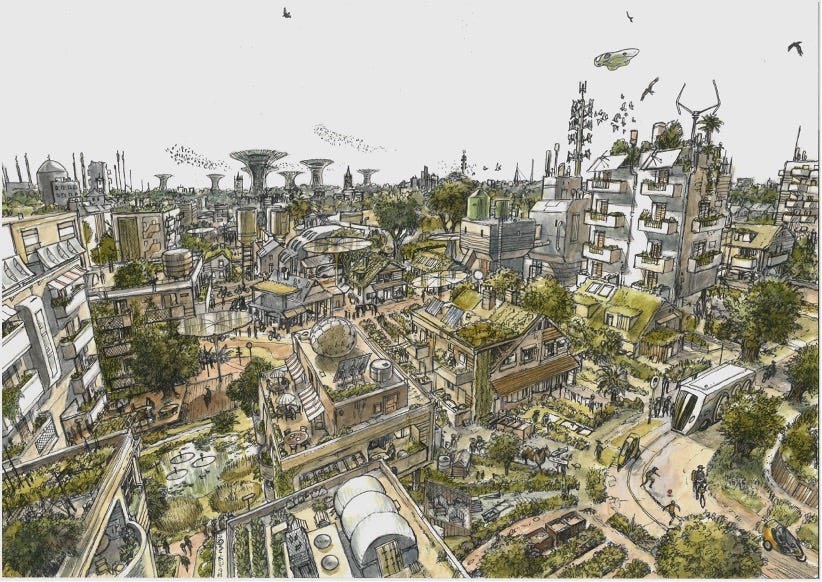
Image Credit: James McKay
CITY CLIMATE EMERGENCY
This climate emergency is also a ‘city emergency’. Most of the world’s population will soon be urban. Cities are locked in to high energy throughputs, are responsible for about three-quarters of global GHGs and energy use, have ecological footprints larger than their city limits, and remain locked in to high-growth, high-consumption lifestyles.
In the context of growing awareness of the severity of climate breakdown, the central role cities play in this, and the lack of rapid action, municipalities around the world are declaring ‘climate Emergencies’. To date 40 municipalities in the UK have signed such a declaration. Worldwide around 50 million now live in cities that have declared emergencies. This is an exciting addition to city level action through, for example, the C40 Leadership Group and the Global Covenant of Mayors.
Tackling head-on the way we live in, manage and design cities makes sense in terms of responding to the climate emergency. Changing city life offers significant and immediate GHG reduction potentials. It also offers a range of co-benefits. City redesign can address long standing urban problems - poverty, segregation, planning blight, air quality, environmental degradation, land ownership, and citizen disengagement.
This discussion document is intended for all those who are interested in supporting city redesign in the face of the current climate emergency. It focuses on four action areas of a city roadmap that respond to the 1.5° GHG reduction challenge. Together, they represent ideas towards a Civic Plan for a Climate Emergency that can be used by policy makers, researchers, civic and business leaders alike to start to understand and take action on the scale and nature of the task.
THE 1.5° CITY DEFINITIONS & CHALLENGES
The overarching framing is how to redesign city life, infrastructures and institutions to meet the target set at the UN talks at Paris in 2015 - to hold global temperature rises to no more than 1.5° of global warming. The IPCC is clear that to meet this challenge it will require transformative and unfamiliar action. Global society has to reach zero GHG emissions by 2050. The task has to start immediately with year on year action working towards this zero end point. Delaying only makes our ability to reach zero carbon by 2050 even more difficult.
But we have much less idea what this means for cities, and especially the smaller neighbourhood scale. This is a significant challenge if declarations for a climate emergency are to be translated into meaningful civic action and public policy, that point to identifiable year on year targets and noticeable changes in daily practices. Exactly how much carbon, what changes, by when, by whom and how? These are the questions we need answers to, and where resources and insights are required.
The task is complicated on a number of levels.
First, the scale of the task requires system redesign. We have run out of options to keep on making adjustments. What is required is fundamental redesign of city systems such as food, energy, retail, local services, transport, housing and work. The requirements for change embedded in these sectors will often be unfamiliar to established city actors and officials. They will need broad cross sector teams to co-produce solutions.
The level of change required not only changes the scale and direction of particular city systems. It also changes how they function. So for example, there will not just simply be less journeys made by cars, or shorter food miles or business supply chains. As changes become deeper and widespread in the 2030s, city systems will start to functionally change. This difficult to understand from the current model of globally-connected high-growth city development. High growth targets, linear throughputs and extraction, will be replaced by a more localized, steady state and circular economy, and a focus on the type of development, resilience, well-being and quality of life.
Second, cities do not represent a level playing field. Cities with higher levels of GHG emissions need to act quicker and more boldly. Those with historically lower emissions, especially in the global south, are able to reduce their carbon use more gradually, especially to support zero carbon technologies and infrastructures, and converge around a common global average. While we have to achieve an average citizen carbon emission profile of around 3 tonnes of Co2 equivalent per person by 2030, what is clear is that many city dwellers across the world, mainly in the global south, already live below this. Many advanced northern cities and rapidly expanding global south ones, especially those with poor transport systems, urban sprawl, and rapidly expanding middle-classes, have emission profiles which if left unchecked commit the world to well over 3° of global warming. This is a rapid wake-up call that prompts a new purpose for city life in middle and high income countries.
Third, rapid GHG reductions have to go hand in hand with delivering a range of co-benefits, especially those associated with the UN Sustainable Development Goals, and SDG Goal 11: ‘making cities and human settlements inclusive, safe, resilient and sustainable’. Rapid city carbon transitions need to be based on a commitment to social equality in terms of outcomes and procedures, and rebalancing who has benefited from growth historically.
Fourth, confusions can emerge over definitions and timescales and these have important effects. Many cities declaring climate emergencies have set their sights on carbon neutral by 2030 targets. Others are using zero carbon targets and timescales with various dates between 2030 and 2050. Cities in the global north are usually ahead of the carbon reduction game compared to their host nations. Therefore, they potentially have the ability, base lines and leadership to create roadmaps that can get to zero carbon earlier than the 2050 target. But the important point is to avoid cherry picking timescales to make the task more or less easier. There are marginal differences between endpoints within a decade range. They all require immediate, far reaching and rapid action. Targets need to be meaningful not aspirational.
Whether targets refer to zero carbon or carbon neutral is important. Zero carbon concerns getting as close to zero emissions as possible, taking into consideration remaining residual emissions that cannot be eliminated easily. Negative emissions activities that actively sequester carbon emissions address this residual element, and these can come in various forms – but again we need to be wary of big tech geoengineering options compared to more localized, nature-based solutions which are more accountable and offer co-benefits.
In contrast, carbon neutral targets can open up unintentional easy wins and short cuts through emissions offsetting and trading, for example buying-in carbon savings from other locations or activities and delaying city-based changes. This is an understandable route given the difficult and unpopular changes that a zero carbon city roadmap entails. Cities adopting ‘carbon neutral’ targets need to watch for these issues and build towards real zero carbon changes detailed below, that also offer a host of co-benefits for citizens.
Fifth, the task is made more complex when Scope 3 emissions are considered. Scope 1 and 2 refer to direct GHG emissions and indirect electricity emissions that can be accounted for by activity in a given city. Scope 3 refer to other indirect emissions that result from consumer and travel activity outside city boundaries and outside the control of the city. In middle and high income cities with high consumption activities, Scope 3 can be sizeable. Air travel and the purchase of consumer goods and services from outside cities is huge. The growing levels of aviation use for business and leisure, big brand, fast fashion, and global corporate-led retail is of particular concern here. But cities are currently not required to account for them as part of target setting. This makes meeting zero carbon targets a more manageable task. It also allows a city to overlook and permit the unchecked growth of emissions from these activities, as well as the range of dis-benefits around debt, air pollution and the loss of local retail. At the moment, emissions from air travel and those from the flow of global goods are not clearly accounted for. Bringing them back onto a city balance sheet changes changes the nature and scale of the task. It focuses policy attention on localization and significantly restricting externally dependent consumer habits and aviation.
CITY CLIMATE EMERGENCY. FOUR ACTION AREAS
CITY ACTION 1. CREATE ZERO EMISSION CIVIC ENERGY
The first action area relates to the city energy system. Most cities are locked in to ageing centralised, corporate-controlled and externally dependent energy system unfit for the challenges ahead. Through their buildings, leisure, tourist and retail habits, transport, workplaces, producer and consumer services, cities are vast non-renewable energy users. Current city energy systems lock citizens into a brown energy commodity that is designed for profit rather than creating an energy commons that underpins a flourishing life for all. The negative results are localised pollution, increases in greenhouse gases, fuel poverty and high utility prices.
Beyond the low hanging fruit of energy efficiency gains and the introduction of low carbon technologies, the challenge is to embark on a large-scale shift to a city energy revolution based on an 100% municipally owned, green and affordable energy supply. Municipal energy companies modelled on the German Stadtwerke can generate from 100% renewable sources within a city-region and replace corporate energy provision. Innovation needs rapidly unleashing across distributed energy networks, district heating, local smart grids, community energy, zero emissions community-led developments, Combined Heat and Power (CHP), onshore wind, solar photovoltaics, anaerobic digestion, energy storage technologies, and the new skills that will underpin these. New planning regulations and mass retrofit programmes are needed to ensure every single building becomes zero carbon. This alone is no easy task, but needs to be a policy priority with its own city directorate.
A vast transfer of currently brown energy subsidies, taxation and legislative change underpins this. The new civic energy sector means the age of the large power plant is replaced with a constellation of distributed but highly connected small and medium zero emission and affordable energy providers. Every home, garden and street becomes a micro power station. The potential is huge. Part of the equation is also demand reduction as city life becomes more localised and less energy dependent. Civic action will also play a role in reinforcing the need for a moratorium on fossil fuel investments and extraction.
CITY ACTION 2. CREATE A CAR-LITE, SOCIALLY JUST MOBILITY PLAN
The second area of action is mobility - the urgent task of how and why we need to unpick city life from fossil-fuel automobile dependency. The rise of the private fossil fuel automobile has brought a basket of negative consequences; road deaths, air pollution, GHG emissions, geopolitical conflict, consumer debt, status anxiety, obesity, the decline of public street life.
In just over one hundred years, the car has seen a spectacular growth – from only a few thousand to over one billion. While ‘car culture’ feels entrenched, it’s history is so brief it can be reversed. But this requires action across culture, infrastructure, work, organisation, behaviour, finance, marketing, and politics. In particular, it requires vast shifts in subsidies to green and affordable mobility and planning decisions that prohibit all new private car based activity. Driverless cars may yield emissions gains. But they will not address the decline of public street life, status anxiety and debt.
Action in this area goes beyond addressing the technical issues of street redesign, and the low hanging fruit of options like bike lanes, and mass rapid transit; although these are essential first steps. Given the high levels of emissions tied up in transport, to meet 1.5 targets, cities need a radically different approach to mobility - to create a socially just, zero-carbon, city-owned mobility plan. This shifts mobility away from the car by eliminating the conditions that make cars necessary.
By 2030, half of all journeys will need to be taken by bus, bike or walking. All remaining vehicles will be EV. These kinds of ambitions involve comprehensively redesigning the automobile out of cities through the roll out of city-region mass transit linking all settlements with non-road mobility options, the implementation pro-walking, car free neighbourhood planning, micro-mobility options around e-Bikes, the reinstallation of integrated neighbourhood transport interchanges, the progressive closures of roads as other options come on stream, and the remunicipalisation of mobility ownership and regulation. The co-benefits of this mobility transition are huge in terms of air quality, road safety, local retail, health spending, journey times and costs, and a quality of life.
CITY ACTION 3. CREATE A NEW CITY ‘NATURE DEAL’
The air, water and land ecosystems that cities and their citizens depend upon are being intensely degraded, and resources are being rapidly depleted. Access to natural areas is restricted by urban sprawl, dereliction, retail, highways and industry where residents have little connection with the natural systems that underpin daily well being.
The challenge is to comprehensively get nature back at the heart of city development, to purify air, capture carbon, reverse species decline and offer wellbeing effects. Restorative and regenerative practices need to be central to urban policy and planning decisions. This includes approaches such as rewilding, permaculture, urban agriculture, continuous productive urban landscapes, and blue-green infrastructure. Natural systems need to be revalued not as a degradable, replaceable and free resources but playing key roles in create climate safe and resilient cities.
Biophilia is emerging as an urban design approach which can replicate the experiences of nature into cities in ways that reinforce the connection between people and nature. Biomimicry is also being used in cities to emulate the complex engineering and design principles found in the natural world in ways that can tackle climate breakdown, water stresses, air quality and biodiversity loss. Practical applications are readily applicable and need to be central to urban development through hybrid natural-city features through living walls, rooftop farms, vertical gardens, water-centric design and breathing buildings.
CITY ACTION 4. CREATE CITY COMMON-WEALTH
The contemporary city is marked by a growing gap between the haves and the have nots, a deep and lasting sense that for many urban residents, city development is not benefiting them. Civic democracy faces a perfect storm of budgetary cuts, increasingly complex problems and a legacy of silo working. All of this is eroding public confidence in the ability of municipalities to take effective action. City economies no longer attempt to distribute wealth and address income and social divisions. Instead, large capital enterprises are facilitated to extract wealth and privatise land and assets.
This challenge area involves significantly shifting the function and role of the city economy so it can support community wealth building activities. Retaining and recirculating city wealth at the neighbourhood level is an effective way to create capacity amongst cross-sector civic teams so they can co-create socially just, climate safe initiatives. Civil society is bursting with potential, initiatives and skills which are effective in responding to the climate crisis and building community resilience.
Examples include citizen housing, common ownership of assets, citizens forums, participatory budgets, local procurement through anchor institutions, tenant and renters unions, workers co-operatives, community-based and open-source digital manufacture, neighbourhood enterprise and maker spaces, crowd sourced city plans. New city wide institutions can retrain and reskill those in the construction industry to roll out a house by house retrofit and insulation programmes. Job to job transitions will be required to meet the task of zero carbon, socially-just city roadmaps. Trade Union partners will play a key role here.
Significantly, there will need to be large scale rezoning and reallocations in land use to support GHG removal activities and the mass shift to plant based diets. Planning frameworks will need to be redesigned around metrics linked to city carbon budgets and SDG indicators. Drawing on windfalls from changes in taxation and subsidies, the role of municipalities shifts towards enabling this civic wealth and climate resilience building.
MOVING FORWARD
Declaring a climate emergency at a city level is an important initial step in responding to current events. It sets a tone and sense of purpose. Its needs to be owned by a cross party coalition and multi-sector city partnerships. But the hard work starts after this. City leaders and citizens need to carefully understand the transformative and ‘step change’ nature of the changes needed in different areas of city life as explored above. Changes will be required that will be challenging, unfamiliar and far reaching.
To facilitate these, important missing pieces of the jigsaw include a common understanding of the challenges and solutions, enabling changes in daily practices, and broad participation and engagement with city residents. Two proposals emerge in this context.
A CLIMATE EMERGENCY HUB
A first step is creating a Climate Emergency Hub. Key to unlocking rapid and meaningful change in cities is a broad and comprehensive understanding of the challenges faced and the kinds of solutions that will work. While the urgent scientific and policy messages around the climate emergency are readily available, they are inconsistently understood and applied locally.
The Hub fills this gap. It initiates collaborative learning, peer-to-peer exchange, in-depth training, demonstration, information sharing and coproduction. It involves basic foundational training in key issues around the climate science of the 1.5° target as well as how these are translated into ‘step change’ city public policy choices. Playing a key role here will be community based knowledge about what works supported by expert research knowledge about the detail of the challenges and technical issues. City wide commissions or forums along with university and research partners will be vital in terms of creating a knowledge base, networking, linking and supporting.
Key to the work of the Hub will be understanding change that is both rapid and deep, but that also is economically feasible, socially fair and ‘brings people along’. It will focus on the positive vision for change and the co benefits that can be delivered. A key element will be sharing demonstration and replication, setting aside city land and assets to rapidly prototype, share and learn from emerging best practice. These kinds of hubs will have a bigger impact through a network of venues spread across a locality.
CLIMATE EMERGENCY CITIZENS ASSEMBLIES
In the context of an emergency, we need a new kind of civic politics. After declaring a climate emergency at a city scale, a second essential element is to reach out far and wide across diverse communities. While much is known about the technical issues of carbon reduction roadmaps, the challenge is engaging the hearts and minds of citizens, understanding, listening and empathising with fears and concerns, gathering ideas for positive action, and getting to grips with the kinds of changes in everyday practices that need to be made within institutions and neighbourhoods. This ultimately leads to the creation of a ‘Citizen Climate Emergency Plan’ and neighbourhood-based structures which can create ownership of the challenges and translate these into action on the ground.
A citizens assembly can be supported by online platforms such as those used during the West Midlands and Manchester mayoral elections
http://www.peoplesplangm.org.uk/
. The assembly would be formed from a broad spectrum of city voices. Established forms already exist such as the ‘Democracy Matters’ citizens assembly model. In this format a Citizens’ Assembly is a group of people brought together, broadly representing the diversity of the population, to deliberate on issues. The design of a Citizens’ Assembly provides an opportunity for a cross-section of the public to hear from experts and campaigners and to engage in considered, thoughtful and reasoned discussion of the issues, while calibrating action to the challenges. The end goal of the assembly is to work closely with the municipality, to make recommendations and play a scrutiny and oversight function, holding elected leaders to account on key milestones and deliverables.
***
The above represents a brief introduction to key issues and action areas. The aim for municipalities in the wake of COP30 now is to act meaningful and set up mechanisms and processes to begin substantial debate and action planning on the first critical decade ahead. Clearly, there are limits to the powers and resource base of UK cities, and these limits needs to be addressed urgently. City plans need to be supported by national climate plans, with a commensurate transfer of resources and powers. There needs to be national alignment through favourable national primary legislation to fundamentally shift the allocation of subsidies, infrastructure planning and taxation.
From this needs to emerge a new positive vision for city and town life as they embark on a 1.5° zero carbon roadmap. Foundational to this is understanding, listening to and connecting with the real and everyday concerns that people have in the context of rapid change. Positive changes and co-benefits in well-being, mobility, homes and neighbourhoods, workplaces and finance need to be highlighted and celebrated. City leaders and citizens need to come together and jointly own the actions and benefits associated with the changes ahead. While this is a climate emergency, it has the potential to be deeply positive, addressing many of the stubborn problems that have plagued cities for generations. From hereon, every year counts. We need to think big, start small, but act now.
Ready to Make Change?
After three decades of research and activism, I'm always looking for partners who want to create sustainable, just, and resilient futures.
Start a Conversation →