Doughnut economics, degrowth and decoloniality
New directions for the Doughnut Portrait method
In my recent article “Doughnut Economics, Degrowth and Decoloniality: New Directions for the Doughnut Portrait Method” with my colleagues Milena Büchs, Catriona Rawsthorne, Joel Millward-Hopkins and Anisha Solanki we explore how degrowth and decolonial approaches can strengthen and extend the Doughnut Economics “Portrait of Place” methodology, particularly in light of accelerating climate, ecological and social crises conceptualised as a global polycrisis. We position the Doughnut model as an influential framework for reimagining economic purpose and local decision‑making, but argue that its existing applications could more fully engage with degrowth and decolonial thought. We investigate how these traditions can be more explicitly embedded across each of the model’s four lenses—local‑social, local‑ecological, global‑social, and global‑ecological—to better support transformative place‑based action.
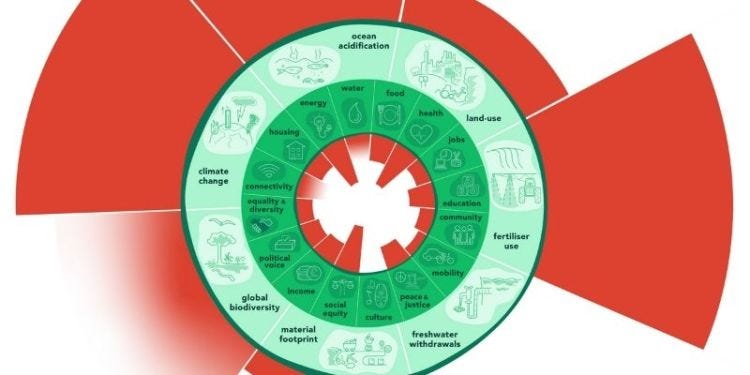
Our article begins by outlining the foundations of the Doughnut model as developed by Kate Raworth. The Doughnut represents a “safe and just space for humanity” bounded by an ecological ceiling defined by planetary boundaries and a social foundation based on social minimum standards, often linked to the SDGs. The model has been widely taken up by municipalities and civil society groups, supported by the Doughnut Economics Action Lab (DEAL), which created the four‑lens “Portrait of Place” approach. This unpacks a locality’s relationship to global ecological processes, local ecosystems, global social impacts and local social conditions. Since 2020, the methodology has been used in cities such as Amsterdam, Barcelona, Glasgow, Portland, Melbourne, Philadelphia and Sydney, along with Leeds, where we were closely involved (see our Leeds study here). The rapid uptake of the model constitutes a notable achievement in translating a heterodox economic concept into applied, place‑based governance.

Our paper situates itself within an emerging academic literature exploring Doughnut economics, but identifies an underdeveloped discussion concerning how the Portrait method intersects with the concepts of degrowth and decoloniality. For us, this is a significant oversight given the scale of the polycrisis, which demands forms of transformation that exceed the incremental or technocratic adjustments still characteristic of most policy responses. We note the growing recognition, in both academic and activist contexts, that deep‑rooted inequalities, extractive economic systems and historical power relations rooted in colonialism are central drivers of ecological breakdown and social injustice. Degrowth and decolonial approaches are presented as bodies of thought offering more radically transformative orientations that could meaningfully expand what the Doughnut model makes visible or thinkable.
We therefore first clarify how degrowth and decoloniality are approached conceptually. Degrowth is framed as a heterogeneous movement encompassing academic scholarship, grassroots experimentation and political mobilisation, but unified around the argument that economies oriented toward unending GDP expansion are incompatible with ecological limits and social justice. Degrowth perspectives foreground the structural impossibility of absolute, global decoupling of GDP from resource use at the required scale, and propose instead a voluntary, democratically planned reduction of energy and material throughput in wealthy economies. We aim not for austerity but for improved wellbeing through redistribution, reorientation of provisioning systems, collective sufficiency, reduced inequality, and diverse non‑market forms of organising. We highlight proposals associated with degrowth, such as universal basic services, work‑time reduction, progressive taxation, decommodified housing, community‑led enterprises and localised provisioning systems.
Decoloniality, by contrast, is rooted in anti‑colonial struggles and intellectual traditions that critique the ongoing legacies of colonial domination in shaping knowledge, power and material relations. Decolonial approaches emphasise that colonialism is not merely historical but persists through global political economy, racialised inequalities, and dominant epistemologies that marginalise Indigenous and subaltern perspectives. We highlight concepts such as Quijano’s “coloniality of power,” the racialised structuring of global capitalism, and the way climate and ecological vulnerabilities are produced through centuries of extractivism and dispossession. Decolonial thinking foregrounds the experiences of those subjected to racialisation, exploitation and marginalisation; challenges Eurocentric and technocratic framings of climate response; and calls for transformations that privilege non‑Western knowledges, more‑than‑human relations and global justice.
Having outlined these traditions, we discuss their relationship to the Doughnut model. Many scholars interpret Doughnut economics as aligned with post‑growth or even implicitly degrowth perspectives, especially given Raworth’s scepticism about green growth and absolute decoupling. However, Raworth’s “growth agnosticism” is presented as a pragmatic rhetorical strategy that avoids alienating mainstream audiences. Some critics see this as a limitation, as it avoids directly confronting the growth imperative; others interpret it as an entry point for broader systemic critique. Decoloniality, meanwhile, is much less explicitly embedded. Although DEAL’s guidance increasingly references colonial legacies, we argue that the Doughnut still largely reflects a Western epistemological framework—for example in its reliance on the SDGs and planetary boundaries, or its visual metaphor of the “doughnut.” We highlight emerging efforts to adapt the model in culturally specific ways, such as using a spiral in Māori contexts or a peace symbol in China.
The core of the article examines each of the four Doughnut lenses, reviewing existing Portraits and identifying how degrowth and decolonial approaches could deepen them. Let’s have a look at each in turn.
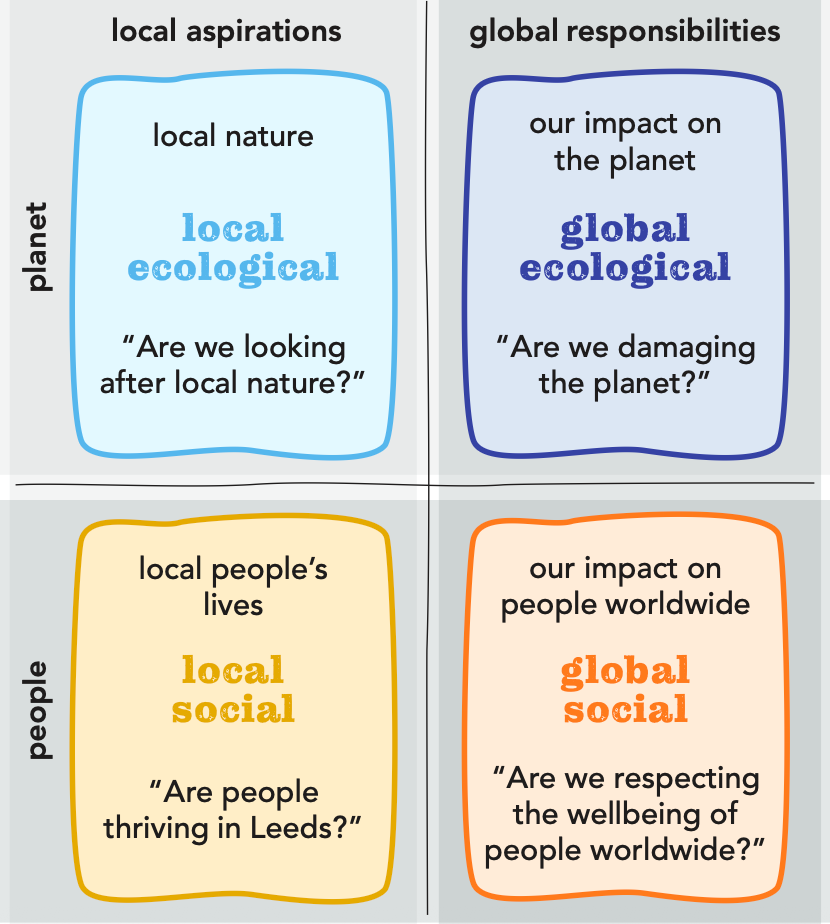
For the local‑social lens, which evaluates whether local residents are thriving across dimensions such as housing, health, education and equality, we note that most existing portraits rely heavily on SDG‑derived indicators and avoid overt references to degrowth or decoloniality. While understandable—given the desire to maintain broad stakeholder engagement—this risks reproducing assumptions about growth‑led wellbeing and ignoring the local manifestations of racialised or colonial power relations. Degrowth perspectives would shift the analysis from access‑based indicators (e.g., employment levels) toward assessing the quality, sufficiency and distribution of foundational goods and services, while questioning whether local economic strategies rely on extractive growth logics. Decolonial approaches would foreground experiences of racialised harm, structural inequalities and local expressions of coloniality—such as policing disparities, housing displacement, precarious labour markets, or the effects of migrants’ transnational climate vulnerabilities. We emphasise that such analyses could make visible uneven social harms previously obscured within the ostensibly neutral framework of SDG benchmarking.
The local‑ecological lens, which examines the state of local ecosystems and their capacity to support life, shows slightly more innovation across existing portraits, but remains limited by data availability and technocratic framings. Degrowth and decoloniality push this lens toward recognising multi‑species ethics, the intrinsic value of nature, and the historical logic of colonial domination embedded in practices of enclosure, extraction and ecological degradation. We argue for indicators that recognise uneven access to nature, the legal rights or personhood of ecosystems, and the centrality of Indigenous and community governance of land. We highlight practices such as rewilding, biomimicry, and nature‑based solutions not merely as technical interventions but as parts of a deeper rebalancing of human‑nature relations. The Sydney Doughnut Portrait’s centring of First Nations knowledge is a promising example.
For the global‑social lens, which assesses how a locality’s consumption patterns harm people elsewhere through supply chains, we note that this is the least developed lens across all existing portraits despite its conceptual importance. The dominant method relies on global footprinting techniques to downscale data on labour rights violations, forced labour, malnutrition, pollution exposures and other harms embedded in international trade flows. The Leeds portrait identified, for example, that over 21,000 child labourers were implicated in supply chains supporting the city’s consumption. While this lens clearly touches on issues central to degrowth and decoloniality—extractivism, global inequality, racialised exploitation—we argue that existing analyses stop short of addressing these structural drivers. Degrowth perspectives would challenge local dependence on globalised consumer supply chains, explore ways to reduce consumption, and identify compensatory mechanisms for global justice. Decolonial approaches would explicitly link present‑day supply chain harms to colonial histories and advocate for solidaristic mechanisms such as reparations, climate finance, global twinning, and internationalist coalitions. We highlight the Barcelona portrait as one of the few attempts to integrate decolonial analysis more systematically.
The global‑ecological lens, which evaluates a locality’s contribution to exceeding planetary boundaries, is the most empirically developed due to available data. Portraits consistently show severe overshoot across all boundaries, driven largely by affluent consumption. Degrowth and decolonial perspectives jointly emphasise that overshoot cannot be addressed without reducing material throughput in wealthy economies and acknowledging the historical roots of ecological crises in colonial extraction. We stress the unequal distribution of responsibility: for example, the Leeds portrait found that while average residents consumed five times the safe per‑capita carbon budget, the highest‑income group consumed eleven times more. Even the lowest‑income quintile exceeded safe limits threefold, illustrating the pervasive ecological intensity of life in high‑income contexts. We argue that this lens should directly inform local strategies for sufficiency‑based economies, redistribution, reduced luxury emissions, support for climate migrants, and deeper engagement with global solidarity networks.
In the conclusion, we emphasise that degrowth and decoloniality offer two main contributions to the evolution of the Doughnut Portrait method. First, they help reveal the interconnectedness of the four lenses, cautioning against treating degrowth as solely an economic issue or decoloniality as only a global one. Instead, both perspectives must permeate thinking across local and global, social and ecological domains. Second, they open debates about the political character of the Doughnut: whether it remains a broadly palatable tool for centrist or mainstream coalitions, or becomes a more explicitly radical instrument aligned with anti‑racist, anti‑capitalist or anti‑colonial agendas. Overall, we note that these orientations are not mutually exclusive: in practice, contexts may call for minimalist (broadly accessible) or maximalist (structurally transformative) uses, and both can coexist within the broader Doughnut ecosystem.
Overall, our article argues that the Doughnut model represents a valuable foundation for rethinking local futures amid the polycrisis, but that its potential will be enhanced by explicitly incorporating degrowth and decolonial insights. Doing so could help reorient place‑based strategies away from growth‑centred paradigms, bring structural inequalities and historical injustices into sharper focus, strengthen the global‑social and global‑ecological lenses, and reshape local governance to foreground wellbeing, sufficiency, multispecies flourishing and global justice. The most lasting contribution of integrating these approaches may be epistemic: decentring economic growth as the organising principle of local strategy, and cultivating broader imaginations of what economies could be beyond the dominant growth‑colonial mindset.
Ready to Make Change?
After three decades of research and activism, I'm always looking for partners who want to create sustainable, just, and resilient futures.
Start a Conversation →