What’s the solution to Broken Britain?
Ideas for the autumn budget and beyond
I recently spoke on the evening news in the north of England about local neighbourhood decline and what to do about it. It is a perennial, frustrating issue and one which occasionally grabs the headlines. The story was running because the Index of Multiple Deprivation had just been updated for England. The IMD is a useful relative measure of overall deprivation in an area, combining features like income, employment, education, health, and housing. The picture was pretty much the same as it has been for decades. With a few exceptions, it is a picture of deep and persistent division between the north and south of England. The most deprived are concentrated in the north, in the central industrial spanning the M62 from Liverpool to Hull, taking in the old industrial cities of Sheffield, Leeds, and Manchester, and reaching up to the old industrial conurbations of Teesside and Tyneside.
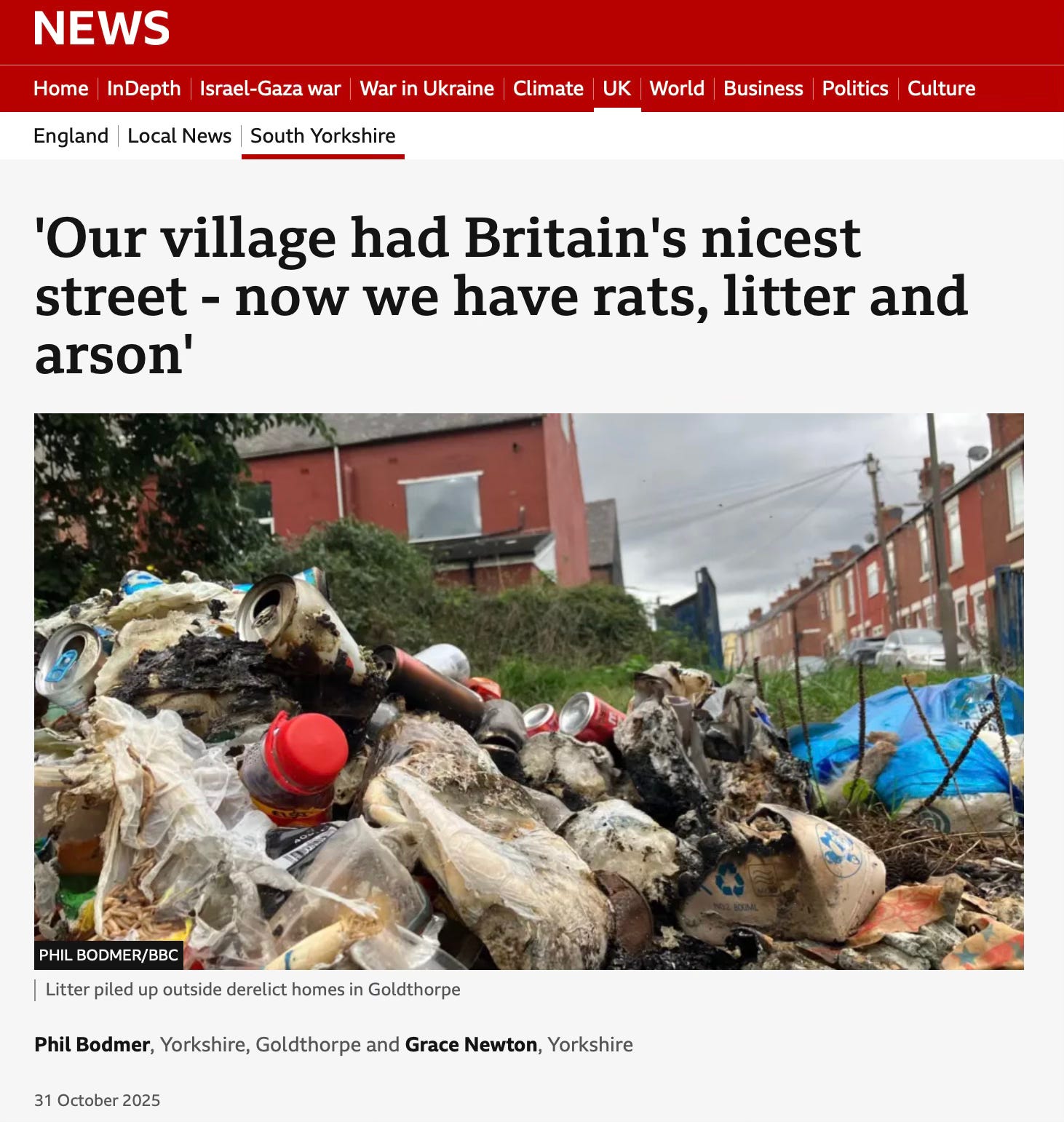
The focus of the news clip I appeared on was an old mining community in South Yorkshire called Goldthorpe. The accompanying eye-grabbing news headline ran: “Our village had Britain’s nicest street – now we have rats, litter and arson.” The article contrasted the current misery and deprivation with happiness seen in the 1970s when there was a strong sense of community and jobs in the coal industry to back this up. When the presenter asked me how these communities had got into such a mess, I was fascinated by the absence of a broader understanding of the recent history of our country. I stressed that this is nothing unique to somewhere like Goldthorpe; in fact, there are dozens of places like this across the north of England and beyond. But this decline is an opportunity to tell a broader story of what’s happened in our country over the last 50 years. This is not a story that is commonly understood or talked about, but it is urgent that we own it and respond appropriately. It goes something like this.
Britain was ravaged by a deep process of deindustrialisation throughout the 1970s and into the 1980s. This was a global story as emerging economies, especially in Southeast Asia, began to rapidly industrialise. A whole host of economic factors, including higher labour, energy and other costs at home and cheaper taxes and less regulation abroad, led industrial activity to rapidly shift from places like the UK to emerging economies in the Global South. Of course, countries like Britain had a choice and could have protected their rapidly declining industries. But this was the age of Thatcherism, and Margaret Thatcher from 1979 was a keen advocate of free-market monetarism. What we saw over the next 20 years under the Conservatives was little protection for declining industries, unlike some countries that adopted industrial policies to safeguard jobs, and a huge transfer of wealth and power from the productive sector to the financial sector. The City of London and the Southeast grew phenomenally at the expense of the old industrial heartlands. The interesting thing is that while this blew up the north–south divide to unprecedented levels, in a much longer view this was nothing new. The north–south divide has been around since at least the Roman occupation of Britain – feeding off the built-in differences in terms of soil, land, and climate either side of the divide - a diagonal line which roughly runs from the Bristol Channel to the Lincolnshire Wash.
While the end of Thatcherism and Blair temporarily stopped the relative decline of these deprived northern communities through a range of innovative social measures, not least Sure Start centres, the downward spiral continued in the age of austerity under the Tory-led coalition from 2010. Fifteen years of austerity and reductions in local authority budgets pushed already deprived communities to breaking point, depriving them of essential services, infrastructure, and people on the ground to make a difference. We also had the global financial crisis of 2008, which accelerated divisions of wealth between people and places to new heights, as trillions were shifted from the public sector to private wealth, mainly through quantitative easing to bail out a selection of banks.
The Brexit vote in 2016 was a huge show of dissatisfaction amongst the ‘have-nots’ in these deprived communities towards centrist governments who had failed to meaningfully respond to a deterioration in their living conditions. But the hard truth was that the process of leaving the EU was not about responding to the real structural causes of deprivation across England. We then come to the final factor: the Covid pandemic. Since 2020, there has been further huge transfer of wealth from lower-income to high-income groups as government’s artificially supported and inflated the cost of assets. Putting all these aspects together, it is completely understandable how communities like Goldthorpe are facing such deep-seated levels of deprivation. In fact, I am surprised that, given everything that has happened, it is not much worse.
While I only got a chance to say all this in summary, the next question was: what should we do about it? Again, the key thing is to match solutions to the scale of the challenge, and it becomes patently obvious what we need to do. It rests on four things. First is the recreation of a national industrial strategy where unions and workers sit down with government and industry to map out the needs of the nation and how we can develop meaningful work and embark upon a green transition. Second, there needs to be not just a reinstatement of local authority finances, but also a massive increase. This can ensure local authorities across the country are in the driving seat of implementing and leading people-centred changes across transport, energy, food, housing, education, and employment. Third, and to pay for all this, we need a wealth tax. This idea has come of age through people like Gary Stevenson, and ideas such as doughnut economics and community wealth building/, and is a sensible way to raise the kinds of billions we need to regenerate our country. Not only this, but we need to curb the spending habits of the country’s super-rich who are indulging in luxury consumption and pushing us to the brink of climate breakdown. When we have over 3 million high-net-worth individuals (with assets of up to £10 million), we know that something has gone wrong in the broader morals and ethics of our country. The final piece of the jigsaw is a massive renaissance of community power, not just tokenistically through the community ownership of pubs or post offices, but a significant transfer of power through the establishment of community enterprises, community cooperatives, and land trusts. We need to stop disposing of public assets and promote a wholesale shift of resources and power to community groups so they can innovate and bring forward solutions to social inequality, ecological breakdown, and rising carbon emissions.
“So no easy solutions then?” asked the presenter. Unfortunately not. I made almost exactly the same arguments 25 years ago in one of the first pieces I wrote as an academic. But while it is not easy, it is also not impossible. Part of the starting point is understanding the problems we are up against, owning a story of how we got here, and then coming up with the appropriate solutions. It’s an approach I’ve been taking in my latest book, How to Save the City. We need a strategy for change which understands the deep causes of social and economic inequality. We have to form breakaway coalitions of civic actors bringing together those from business, industry, government, universities, and community sectors to embark on a different path. As the Labour government announces their autumn budget, there is an opportunity to shift in the kind of directions I have mentioned above. It will be a long journey, but we need to take every opportunity to start to shift policy, debate, and action.
Ready to Make Change?
After three decades of research and activism, I'm always looking for partners who want to create sustainable, just, and resilient futures.
Start a Conversation →