What can UK New Towns learn from Community led housing?
Ecological Design, Democratic Governance, and Community Ownership in Next‑Generation Settlements
I recently submitted evidence for the The House of Lords Built Environment Committee’s inquiry into new towns and expanded settlements. You can read my full submission here. Below, i’ve written a short summary of key points.
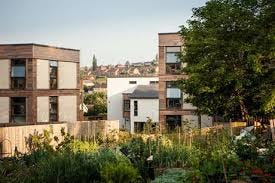
The Lilac project Leeds
In my evidence paper, I emphasise that community‑led housing provides a powerful framework for shaping future UK New Towns. Drawing on my long‑standing research into urban sustainability and democratic urbanism, I argue that New Town development must move beyond conventional, speculative, market‑led approaches and instead embed ecological design, community ownership, and participatory governance at its foundation. In my view, models such as cooperatives, cohousing, Community Land Trusts, and self‑build initiatives demonstrate convincingly that places can be simultaneously low‑carbon, affordable, socially cohesive, and governed by the people who live in them. These approaches also generate wider co‑benefits linked to community energy, local food systems, shared mobility, and circular economies.
A central point I stress is that New Towns require a zero‑carbon placemaking approach. I argue that their success depends less on their geographic location and more on the deeper principles shaping their form and function. This means a decisive shift away from high‑carbon materials, car‑dependent layouts, and the separation of living, working, food production, and services. Instead, I advocate dense, well‑connected, mixed‑use and regenerative design principles, underpinned by ambitious building standards such as the Living Building Challenge. I highlight the importance of nature‑based solutions, passive building design, and distributed renewable energy systems owned at local or community scale. Drawing on examples from continental Europe and emerging UK practice, I underline how community‑owned energy systems can enhance resilience, reduce bills, and reinvest value locally.
I also stress the substantial design and architectural innovation emerging from collaborative housing projects internationally. Examples such as Vauban in Freiburg, BO1 in Malmö, BedZED in London, and our own Lilac project in Leeds show what becomes possible when residents are active shapers of place. These projects demonstrate how natural materials, shared spaces, car‑free environments, and socially rich public spaces can be embedded into neighbourhood design. I argue that custom and self‑build initiatives—common in several European countries—offer important lessons for diversifying supply, unlocking local skills, and enabling small builders and citizen groups to participate in high‑quality development.
A related concern I raise is the structural barrier created by concentrated land ownership and speculative land banking in the UK. I argue that unless New Towns tackle these issues directly, affordability and community benefit will remain out of reach. I therefore advocate a much stronger role for community landownership, cooperative tenure, and intermediate housing markets that de‑commodify land and lock affordability in place permanently. Community Land Trusts, community businesses, and mutual ownership models—already delivering results in the UK, US, and Europe—offer credible pathways for securing land for long‑term public benefit.
I also place strong emphasis on nature recovery and biodiversity enhancement as foundational rather than optional elements of New Town planning. Given the widespread degradation of ecological systems, I argue that New Towns must prioritise rewilding, permaculture, biophilic design, urban agriculture, and blue‑green infrastructure. I outline how food production, carbon sequestration, climate resilience, and biodiversity enhancement can be integrated into everyday urban form. In doing so, I highlight the need for biodiversity banks, rewilding strategies, strict nature‑based design codes, and training pathways that support ecological land management at scale.

In terms of governance, I argue that democratic participation must be structurally embedded in how New Towns are planned, delivered, and managed. Community‑led housing shows that when residents have meaningful power over decisions, places are more equitable, cohesive, and resilient. I therefore advocate mechanisms such as citizen assemblies, participatory budgeting, live planning laboratories, and governance structures that elevate under‑represented groups. These tools, I believe, can help build accountability, foster innovation, and ensure New Towns reflect the needs and values of the people who will live in them.
Finally, I highlight the need for new delivery models underpinned by robust metrics and long‑term environmental accountability. I suggest the use of carbon budgets, Doughnut Economics, land value reform, and community‑controlled development processes to ensure New Towns meet social and ecological goals. I also draw attention to innovative initiatives such as We Can Make and WikiHouse, which show how legal, financial, and technical frameworks can be re‑engineered to place communities at the centre of housing delivery.
Overall, I argue that community‑led housing should be understood not as a niche alternative but as a catalyst for re‑imagining New Town development. Combining ecological design, affordability, participatory governance, and community ownership offers a viable and urgently needed pathway for responding to the intertwined challenges of climate breakdown, inequality, and the housing crisis.
Ready to Make Change?
After three decades of research and activism, I'm always looking for partners who want to create sustainable, just, and resilient futures.
Start a Conversation →